
2025-11-10 https://metro.co.uk/2025/11/08/next-wave-military-drones-mosquito-sized-24654415/ HaiPress
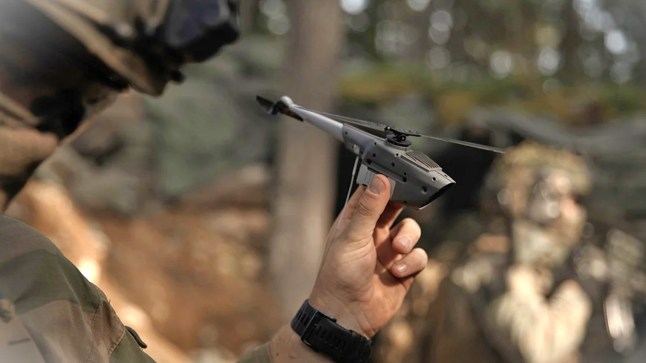
Black Hornet Nano – known as just ‘Black Hornet’ – is one of the smallest types of surveillance drones created by Teledyne (Picture: Teledyne FLIR Defense Inc)
As technology begins to advance,size is starting to matter less as military drones are shrinking down to the siz of a mosquito.
‘Nano drones’,sometimes called ‘micro drones’ are being increasingly deployed on the battlefield as military leaders fully realise their potential as a weapon.
Consumers are already able to buy some on the high street for less than £50,but they are now being rigged with high-tech equipment.
Black Hornet Nano – known as just ‘Black Hornet’ – is one of the smallest types of surveillance drones created by Teledyne.
They provide intelligence to troops on the ground,sending reliable information to get ahead of any incoming targets.
Meanwhile in China,a military research institute has developed mosquito spy drones for reconnaissance and special missions on the battlefield.
But more are on their way,as defence contractors look to somehow make them even smaller.
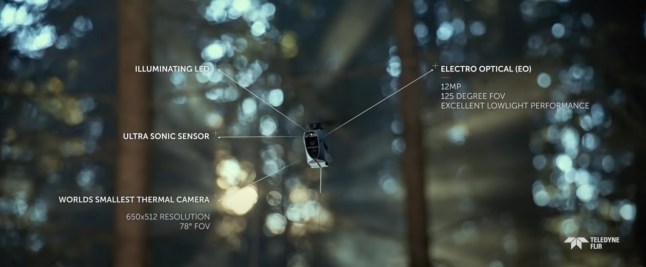
They can be sent out in less than 20 seconds and can fly for more than 30 minutes with a range of 1.9 miles (Picture: Teledyne FLIR)
These dones have incredible capabilities,but currently cost around £150,000 to deploy.
They can be sent out in less than 20 seconds and can fly for more than 30 minutes with a range of 1.9 miles.
They carry sophisticated surveillance equipment,including being able to take night and day video and thermal imaging.
And they are operated through autopilot by being sent to predesignated targets.
The Black Hornet has already been deployed in the Russo-Ukraine war.
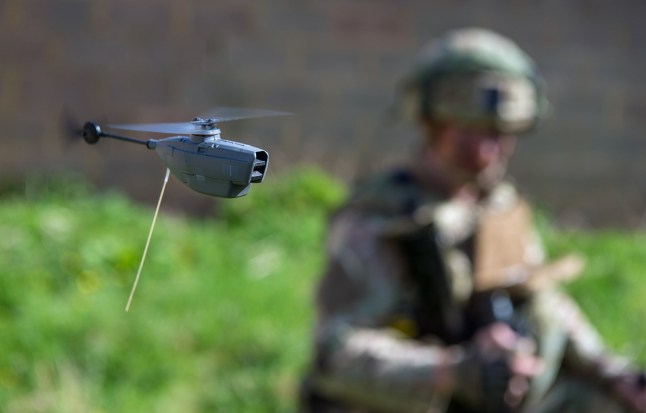
A Royal Marine controlling a Black Hornet 2 Remotely Piloted Aircraft System (Picture: MoD/Crown copyright 2017)
With all the benefits of operating smaller drones,engineers are set to make them the future of warfare.
Being smaller makes them harder to detect and shoot down. They also make less noise,to the point they are almost silent.
And as an additional plus,they are cheaper to manufacture,so if any are lost in battle,it won’t be too much of a loss.
It also won’t be hard to coat them in radar-absorbent materials,increasing their stealth giving them the ability to operate in swarms.
Their size also makes them ideal for precision strikes on infrastructure,they can infiltrate buildings and damage wiring without enemies noticing for some time.

The RoboBee Drone,developed by Harvard in April,is capable of flying and landing like a crane fly (Picture: Harvard Microrobotics Lab)
Researchers at the National University of Defence Technology (NUDT) in China’s Hunan province unveiled a mosquito sized spy drone in June.
Student Liang Hexiang said: ‘Here in my hand is a mosquito-like type of robot.
‘Miniature bionic robots like this one are especially suited to information reconnaissance and special missions on the battlefield.’
And in the US,the Department of Defence’s secretive DARPA lab has also been working on hybrid insect drones since 2006.
But this involves embedding electronics into real insects – such as cockroaches and beetles – which are used for surveillance.
The RoboBee Drone,is capable of flying and landing like a crane fly.
But the current plan for the creation is for environmental monitoring and artifical pollination.
Inside the Air India crash simulation that ‘casts doubt on pilot suicide theory’
Fighter jets scrambled to shoot down drone that entered Nato airspace
More than 100 people leap from blazing boat as fire engulfs children’s tour
The ‘brown challenge’ is spreading across Spain – and it’s seriously disgusting
Local councillor wants to hold a swingers party in his town hall
Explosion at Rotterdam port leaves one dead and several injured
©copyright2009-2020Fresh life
