
2025-04-19 IDOPRESS
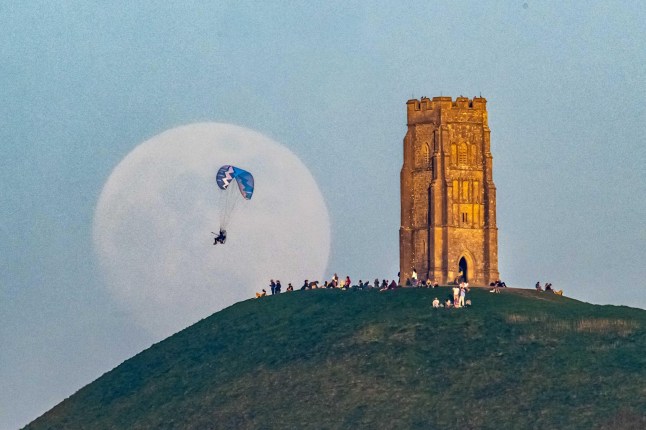
The almost-full Pink Moon rising from behind St Michael’s Tower on Glastonbury Tor yesterday (Picture: Alamy Live News)
Skygazers in the UK are in for a treat tonight,as the ‘Pink Moon‘ is set to light up the skies – along with a unique ‘blue giant’ star.
This month’s full moon is known as the Pink Moon,as it’s the first full moon of spring in the northern hemisphere.
It will be visible alongside the huge star Spica,which is part of the constellation Virgo. In fact,it’s actually two stars,but we see them as one as they are linked together and burn so brightly (well over 10,000 times as bright as our own sun).
Those looking up last night already saw a beautiful show as the near-full moon rose in clear skies. Tonight is slightly cloudier but should still offer a good view as the moon rises.
The moon will technically only become full at 1.22am,but to earthlings like us it will look full well before that. As it’s the brightest thing in the sky,it should be easy to spot.
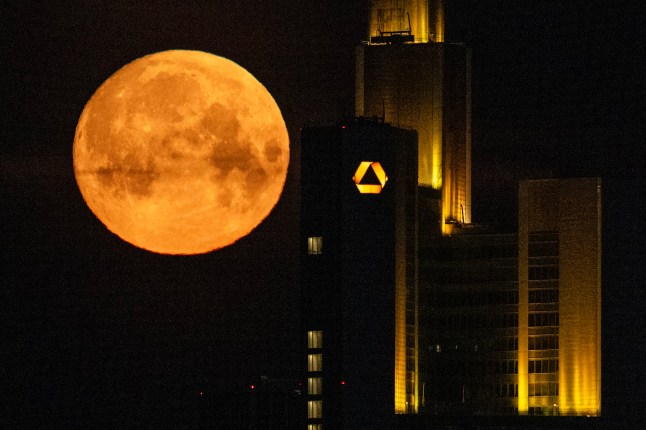
Last night’s moon seen behind the headquarters of Commerzbank bank in Frankfurt am Main,western Germany (Picture: AFP)
Despite the name ‘Pink Moon’,the Earth’s natural satellite won’t actually appear pink: it will be the standard silverly moon-colour we know and love.
The moniker appears to have sprung from Native American tribes,which had names for the moons based on what was going on around them at the time.
For example,the Pink Moon gets its name from the pink wildflowers which bloom in the US each year in early spring.
Known as phlox subulata,the flower is commonly called creeping phlox or moss phlox and can also be known as ‘pink moss.’
April’s moon can also be referred to as the Egg Moon because spring is egg-laying season.
It is also known as the Sprouting Grass Moon,Fish Moon,the Pesach or Passover Moon,and the Hanuman Jayanti Festival Moon,as it marks a time of renewal and life.
Yes: Spica,on the other hand,will glow with a blue-ish hue if you manage to spot it.
This is because it is burning so ferociously that its fire is blue,as opposed to our own cooler sun which is more yellow.
Such massive stars are called blue giants,while our own sun is a yellow dwarf (but it shouldn’t get an inferiority complex; it’s more than enough for us – and it isn’t fated to soon explode in a huge supernova,unlike Spica).
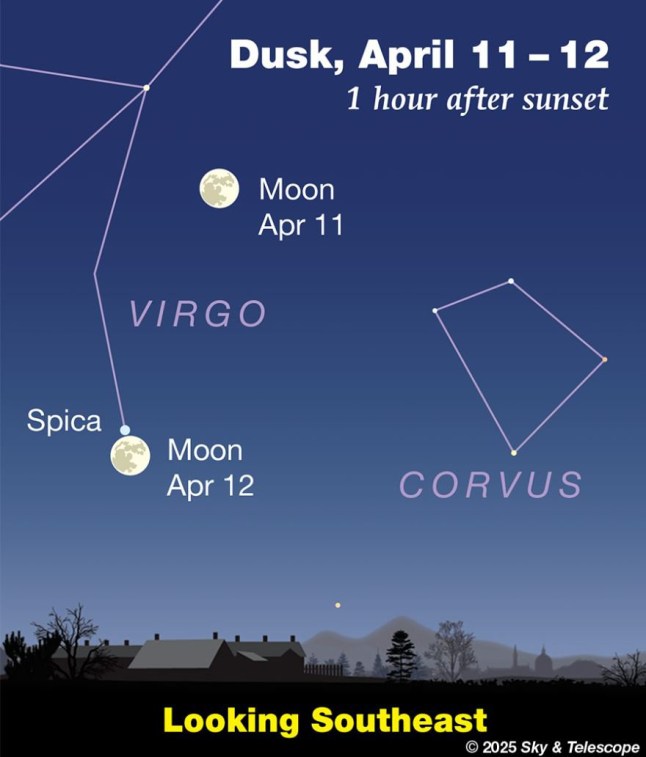
You’ll also be able to see a bright star (Picture: Sky and Telescope)
The best time to see the full moon is Sunday morning at 1.22 am,when the Moon will come out in full force.
This is when it will be its fullest,but it will still appear bright and round for a few nights after.
A full moon occurs every 29.5 days and happens when the moon is completely illuminated by the sun’s rays.
It occurs when the Earth is directly aligned between the sun and the moon.
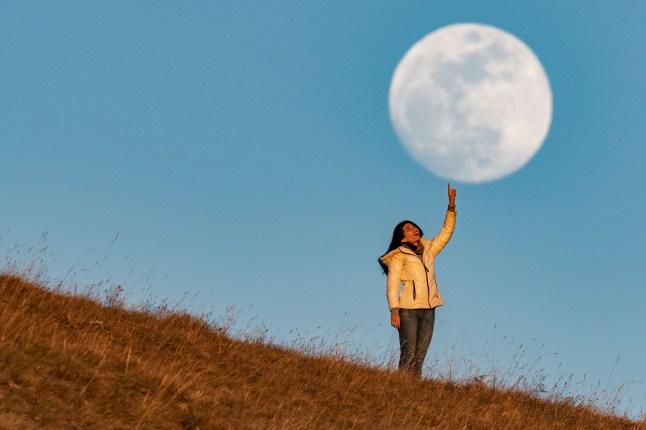
A woman ‘touching’ the Pink Moon in Calascio,Italy,last night (Picture: Rex)
To find Spica,look for the big dipper and follow its handle to find a bright orange star,which is Arcturus.
Then keep going,until you see a bright blue-ish star,which is Spica.
It will first meet the moon at around 10pm tonight in the south east,and as night goes on they will be seen across the south around midnight.
Look to the left of the moon to find Spica tonight. Tomorrow,they will still both be visible,but will have switched positions.
A version of this article was first published on April 11,2025.
Sisters, 14 and 15, disappear without trace within days of each other
Disabled man ‘booted off’ flight after dispute over his wheelchair aid
Trump claims the Strait of Hormuz is now a new US territory
Even dying couldn’t get supermarket customer out of £35 parking fine
Teens killed in wrong-way crash ‘had been terrorising communities for weeks’
ChatGPT can now remember what you do on your computer – and experts are worried
©copyright2009-2020Fresh life
