
2025-01-15
On a winter afternoon, the sun shines into the farmyard in the No. 1 Zen Tea Village in Jingshan Town, Yuhang, Hangzhou. Mr. Huang's family, who came from Hangzhou for vacation, enjoyed tea by the fire in the courtyard of Chen Shujian, a young man born in the 1990s.
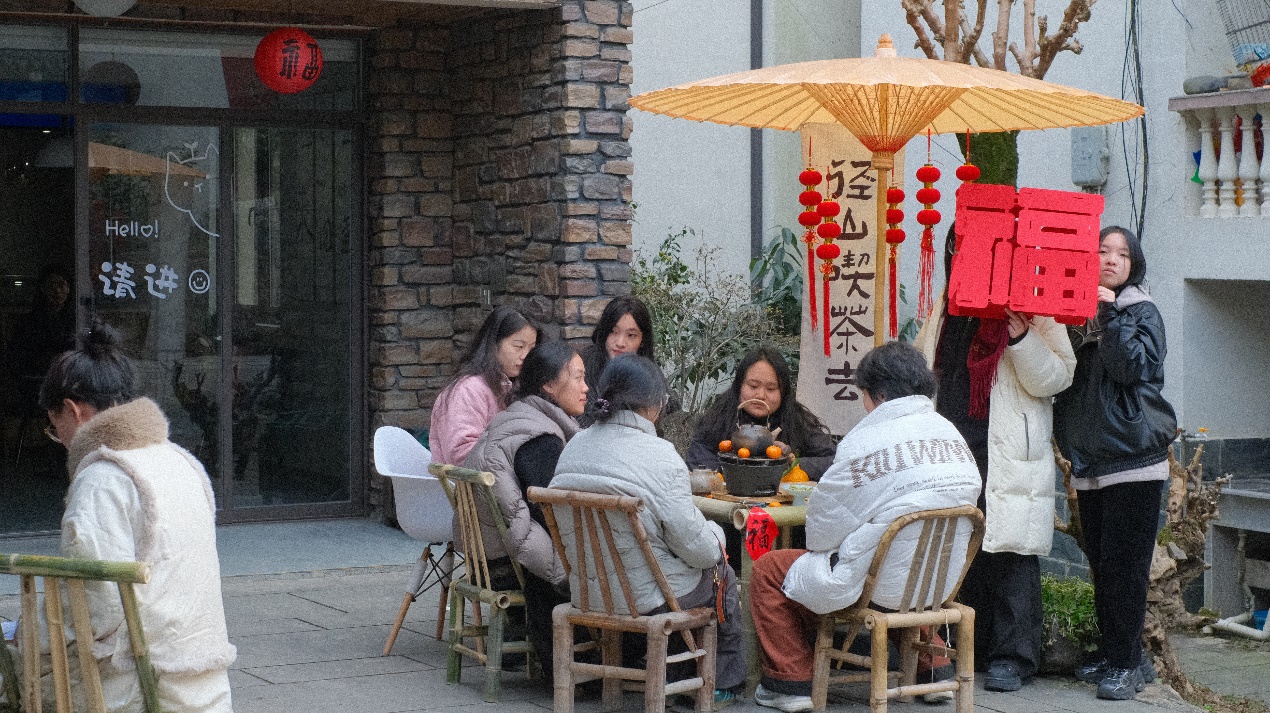
Chen Shujian is from Shengzhou and has baking skills. A year ago, at the invitation of his sister who ran a B&B in Jingshan and had a good business, he gave up opening a shop in the downtown area and chose to settle in Jingshan. He took a fancy to a farmhouse courtyard where the gate here was five or six meters away from the main road, with no walls, resembling an ordinary house. Chen Shujian slightly decorated it, setting up a fireplace, placing bamboo chairs, and pasting Fu characters to create a casual atmosphere. Considering that most of the tourists and villagers are middle-aged and elderly people, he mainly sells Chinese snacks, such as ginger paste made with Eranthis longistipitata, brown sugar and other ingredients, which is very popular. He once worked as a sales manager in a big city, but found inner peace in the slow pace of rural areas.
In another courtyard not far away, Zhang Xiaorui, who is in a wheelchair, was busy. She is a member of Yuhang District Getting Better Disability Services Center, and is responsible for processing training and production of supplied materials in the handicraft workshop of Zen Tea No. 1 Village. The workshop is located on the first floor of a house, and Zen Tea No. 1 Village provides the space for it. After the rise of courtyard economy, disabled friends moved their workbenches and display stands outdoors. The cultural relics they weave, such as bracelets and beads that symbolize good luck and fortune, attract many tourists. The Year of the Snake is approaching, and the demand for snake bracelets exceeds supply. It takes more than 40 minutes for a skilled worker to weave the main part of a bracelet. The stocks on site are quickly sold out, and many pre-orders have been received.
Yu Ronghua, secretary of the Party branch of Jingshan Village, said that Jingshan Temple is very popular and Jingshan tea is very famous. The village uses limited courtyard space to "dig inside and attract outside" to enrich the layout of Zen Village business formats. At present, the Zen Tea First Village has built 12 workshops using idle farmhouses, set up tea-related businesses such as tea whisks and tea snacks, and vigorously developed courtyard economy. This not only shortens the distance between tourists and rural business owners, but also increases the added value of agricultural products, revitalizes traditional handicrafts, and transforms tourists from "getting a passing glance at the scenery" to "dismounting to view the flowers" to a resident tourism. The courtyard economy of Jingshan, Yuhang, is injecting new vitality into rural development with its unique charm, depicting a new picture of prosperous industry and beautiful life, and becoming a vivid practical example of rural revitalization.
Company: Hangzhou Jingshan Tourism Resort Management Committee
Contact: Wang Ling
Email: wdlpr@foxmail.com
City: Hangzhou, Zhejiang
9 PEOPLE BUILT A $10 BILLION DOLLAR ECOSYSTEM IN ONE YEAR
Mystery as retired spy general with links to Russia’s Defence Ministry found shot dead
One confirmed dead after sword attack on first day back at school
Boy, 7, left alone on Mount Fuji by his own dad
Waterparks forced to close over disgusting ‘brown challenge’ that is spreading
Nasa’s ‘SkyFall’ helicopters beam green waves to hunt for ice on Mars
©copyright2009-2020Fresh life
